

Thermal insulation products are among the most important means of limiting heat exchange between spaces of different temperatures, preventing heat from entering buildings in warm countries.
What sets it apart
Key features
Limits heat exchange
Limits heat exchange between spaces of different temperatures, inside and outside the building.
Summer and winter
Reduces heat transfer from outside in during summer, and from inside out during winter.
Hourdi block
Provides acoustic and thermal insulation and is easy to install; used in halls and large rooms.
Energy efficiency
The optimal solution for energy efficiency and protection from temperature swings in buildings and facilities.
Refers to all insulation systems and processes that limit heat exchange between spaces of different temperatures. Thermal insulation in buildings is primarily designed to retain heat inside buildings in cold countries and to prevent heat from entering buildings in warm countries. This is achieved using materials with heat-insulating properties that help reduce heat leakage and transfer from outside the building to the inside in summer, and from inside to outside in winter. Compatible construction methods achieve high thermal insulation efficiency.
Hourdi Block
Hourdi Block
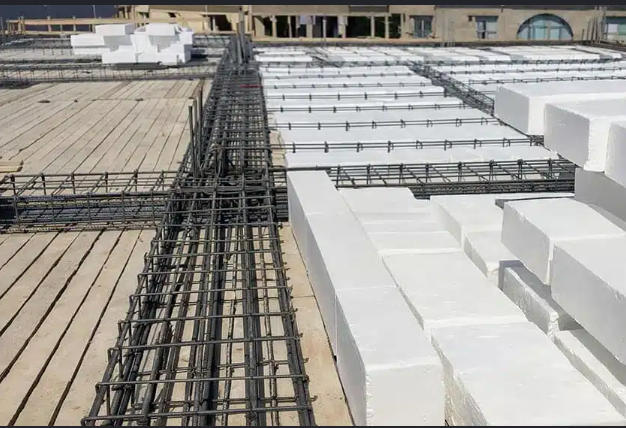
The Hourdi slab is one of the most widely used roofing systems in construction worldwide. Its key benefits are that it provides acoustic and thermal insulation and is easy to install; it is used in halls and large rooms, as column spans can reach 8 meters or more depending on slab thickness and the depth/width of the drop or hidden beams. It is considered the ideal choice for residential homes.
The Hourdi slab concept is simply a steel mesh — a regular 10 cm slab with hidden/drop beams and ribs 20 cm below — with blocks (concrete, red brick, or polystyrene) placed between the ribs to reduce weight, lower concrete and steel costs, and provide acoustic and thermal insulation.
Also available